
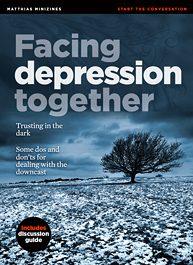
Facing depression together

A few weeks ago I bought this MiniZine from Matthias Media and I finally made time to read it over the weekend.

It has 2 excellent articles on depression, one from a sufferer describing his experience and the difference the gospel makes to those who struggle with Depression & Anxiety.

The other (by Mark Baddeley) is titled ‘Dos and don’ts when dealing with the downcast’ and is an excellent starting point for those who haven’t suffered from depression and find themselves not knowing how to best help those who do. There were 2 things that struck me particularly – probably because I’ve done such a bad job in past.

So if you’re strong and you’re faced with someone weak, your job is to bend down, get down where they are, and lift some of the burden and carry it for a bit. It isn’t to say, “Cheer up mate! Things aren’t as bad as you think. Be strong and trust God.” That is the perennially instinctive thing to say, and it is so because it is cheap.

It is the same kind of love that says “Be warm and well fed, and, by the way, God loves you” when faced with a homeless person. It costs nothing, but just tries to fix the problem quickly in order to remove its challenge to love that person in their concrete situation. It is like the person who intervenes in a supermarket to give the upset child that lolly they’ve just been denied. That person doesn’t care about the child’s welfare; they just want to stop feeling bad because the kid’s upset. The person who really loves the child did something costly and told them ‘no’ when an easier path was clearly open. In biblical terms, such cheap ‘love’ is ‘hate’ that has simply learned to ape its betters. It is faith that is dead, but dead before rigor mortis sets in.

Carrying the burden will look different for different people, but usually it means letting the weak person talk frankly about their life at the moment—listening rather than offering solutions, allowing them to suck some of your emotional energy away, and giving them some of your excess, even if it puts you in the red for a bit.

And

The priesthood of all believers means that I am your priest and that you are mine at the same time. I can be an instrument of the grace of God to you, and you can be one for me. I can pray for you and you can pray for me.

There are times when I can stand before God on your behalf when your faith fails you and you need someone to do for you what you cannot do for yourself, but what you so desperately need to have done. Like the four friends of the paralytic, we can carry the crippled, rip open the roof and present our friend right in the presence of the throne of grace (Mark 2:1-12). And like in that account, it might not always be entirely clear whose faith was the instrument for the grace of God to operate.

What does such faith operating on behalf of someone else look like? It is faith that is active, doing what that person would do if they could do it, and doing it in such a way that it overflows and feeds them.

So rather than encouraging them to pray, you pray for them, and as best as possible, try and express their feelings and perspective to God, and hand the problem to God. Do that with them present. Acknowledge and give dignity to their downcast experience by articulating it in prayer. By doing that, you implicitly show that it is not the final word.

So rather than calling on them to trust God, give them a reason to trust God. Just talk about how great and good God is; how his mercies are ever renewed; how we don’t have to muster up faith to get access to his grace; how he holds us up even as we trip and fall; how the Father who gave up his eternally loved Son for us when he and us were at each other’s throats is a Father who is really there for us now that we are his children. Just talk about God to them—as though that is life itself. And don’t finish by saying, “So buck up and trust him, okay?”; finish by saying, “He’s on your side; he’s going to carry you through this, however bad it gets”. Sometimes it’s okay to just declare the promises of God and not ask for any response in the short-term.

According to a 2007 national survey, there are around 1 million adults and 160,000 young people in Australia living with depression. This is roughly 1 in 5 women, and 1 in 8 men (info from beyondblue.org.au).

Depression is an issue that is going to effect each of us in some way so I highly recommend these articles as a great place to start understanding it better and learning how to care for those around us. You can buy a paper copy here or PDF here. Mark Baddeley’s article can also be read online here.

Confessions of a new believer

Great little series from Hayley.

The quotes have been taken directly from my journal and emails during the early days of becoming a Christian. I’ve tried to keep them as true as possible to the stream of conscience that wrote it – so sorry in advance for the grammar! Some things are just funny and some are insightful.

My hope is that this series of posts “18 Confessions” would deepen the believers empathy for those seeking out the faith and bring insight into the internal wrestles of a new Christian or perhaps if you relate to the thoughts or struggles in these posts that you would consider the lasting satisfaction and joy that is found only in Jesus.

Read them here.

While your there, check out Hayley’s story.

Prevent Official Release of Kanye West’s ‘Monster’ video

A few weeks ago I posted about Kanye West’s new Monster video.

Image from melindatankardreist.com

CollectiveShout and others have sponsored a petition to prevent the official release of the video. I’ve seen the video in its entirety and it is truly disturbing.

– Dead women, clad in lingerie, hang by chains around their necks.

– West makes sexual moves toward dead or drugged women propped up in a bed.

– A naked dead or drugged woman lays sprawled on a sofa.

As soon as this video is released it will be played on Saturday morning music shows to who knows how many boys and girls. Please take a stand against this glamourisation of brutality against women. Sign the petition here.

Think like Jesus

Each of you should look not only to your own interests, but also to the interests of others.
Your attitude should be the same as that of Christ Jesus:
Who, being in very nature God,
did not consider equality with God something to be grasped,
but made himself nothing,
taking the very nature of a servant,
being made in human likeness.
And being found in appearance as a man,
he humbled himself
and became obedient to death—
even death on a cross!
Therefore God exalted him to the highest place
and gave him the name that is above every name,
that at the name of Jesus every knee should bow,
in heaven and on earth and under the earth,
and every tongue confess that Jesus Christ is Lord,
to the glory of God the Father. [Philippians 2:4-11]

God, depression and hope?

Resurgence is doing a series on God & Depression based on Psalms 42 & 43.

I was very excited when I saw the first post – I love the Psalms and I think they tap into human emotions so well. I think the Psalms are a great example of how to express emotions in prayer to God. I particularly think they are helpful for people with depression.

Psalms 42 & 43 are great examples of this so I love that Resurgence are doing this series. However this comment in the latest post concerns me

We cannot live without hope, but there are countless things to hope in. Much of our depression may come from misplacing our hopes as we place too much hope in things which are not God. The Psalmist takes a look at what he has been hoping in — a revealing and convicting thing to do. We will find we need to repent for having our hearts set on things other than God, and in this way, bringing depression on ourselves. [emphasis mine]

This statement might be true for some people but not for everyone. And it seems like terrible advice to give to someone who is dealing with depression – surely telling them they need to repent of their depression (which is what they will hear you saying) is only going to make things harder for them. As for ‘bringing depression on ourselves’ – this is not the case for everyone. Depression is a medical illness for some and needs to be seen and treated as such.

I have read Psalms 42 & 43 over and over. I see no repentance expressed here. But what is beautiful is that 3 times across these Psalms the psalmist express his distress and immediate follows with the statement that his hope is indeed in God, his saviour. That is exactly the turmoil of depression – knowing that we have hope is God but feeling nothing but turmoil and an utter lack of hope. This problem needs grace, love and patience but not repentance.

Why am I so depressed?
Why is this turmoil within me?
Put your hop in God, for I will still praise him,
My saviour and my God.          (Psalm 42:5,11 & 43:5)


Wikileaks and Sexual Assault

I’m honestly sick of hearing about Wikileaks. Especially when it makes people forget that Julian Assange has actually been charged with several claims of sexual assault, including one count of sleeping with a woman while she was sleeping.

I don’t know if he did it or not. But neither do all the thousands of people protesting his arrest.

This morning the ABC reported in this article that Assange’s lawyer

told the court the allegations made against his client by two Swedish women should not be taken seriously.

“It was very clear this is not an extremely serious offence. It is arguably not even a rape offence,” Mr Robertson said.

Unbelievable. Sexual assault allegations should not be taken seriously? And sex with a woman who is asleep is not rape? Well I’m glad this guy is a defence lawyer not a prosecutor.

Attitudes like this make it harder for women to come forward about sexual assault. As Melinda points out

It’s hard enough to report assault at all. The fact is the vast majority of sexual assault crimes are never reported. They never see the light of day for a range of reasons. Many women fear being blamed for what happened.

Read the whole article here.

‘Monster’ is right. And disturbing.

Here’s a sneak peek of Kanye West’s new song Monster.

I find it very disturbing. It gets worse with the Behind the Scenes video I couldn’t finish watching.

Here’s what Melinda Tankard Reist on ABC Drum Unleashed.

Dead women a turn off?  Not at all. Kanye West, on the bed with the two young white dead women, shows no hesitation. He moves the lifeless arm of one onto the leg of the other, before cupping the porcelain like face of the first woman to kiss her.

Hanging from the rafters in stiletto heels, standing rigid in lingerie, expired on a bed. The white women in these scenes are depicted as subordinated to the black man, reminiscent of the pornographic representation of black men who love to ravish white women, to tarnish and spoil their ‘pure’ bodies.

Limp, floppy, rendered powerless these doll-like bodies retain their seductive, sexual allure. Sure, they might be dead. Sure they can’t consent. Sure they wanted it.

I wonder who thought of this scene?

I wonder too. Read the whole article here.

UPDATE:

As bad as the videos are, it gets worse when you read the comments on the drum unleashed article. The number of people who think this is ok scares me. One even says ‘they don’t look dead to me, just stoned’. Frankly I can’t see why that makes a difference – the girl on the bed is being moved, literally controlled by a man, and whether she is stoned or dead she is helpless to stop him grabbing her face to kiss her, or moving her hand onto the leg of the stoned/dead girl beside her. Honestly its the stuff of horror stories. Of course the person who left this comment also said ‘I’m into the bed scene”. Sex with stoned girls. Hot. Apparently.

But what takes the cake is the person who says ‘Kanye West & Jay-Z are both intellectually refined & culturally astute musicians’. Wow. ‘Intellectually refined’ is definitely not the description I’d use of a man engaging in sexual acts with girls who (dead or stoned) are unable to consent to whats being done to them. The only word that springs to mind is rapist.

These attitudes are just plain scary.

Dr Lloyd-Jones on Spiritual Depression

Having thus described [spiritual depression] in general we can now proceed to state some of the general causes of the condition. First and foremost I would hesitate to put – temperament. There are, after all, certain different types of people. I wonder whether anyone i surprised that I put this first? I wonder whether anybody wants to say: When you are talking about Christians you must not introduce temperament or types. Surely Christianity does away with all that, and you must not bring that kind of consideration into a matter like this? Now that is a very important objection and it must be answered. We begin by saying that temperament, psychology and make-up do not make the lightest difference in the matter of our salvation. That is, thank God, the very basis of our position as Christians. It does not matter what we are by temperament; we are all saved in the same way, by the same act of God in and through his Son, our Lord and Saviour Jesus Christ. This is our answer to psychology and to the criticism of Christianity that often results from a study of psychology. Let me make this clear. It does not matter what your background is, it does not matter what temperament you may happen to have been given in this world, all that does not make the slightest difference in the matter of salvation. We do not recognise such a thing as a ‘religious complex’.We glory in the fact that the history of the Church proves abundantly that every conceivable type of temperament has been found, and is still to be found today, in the Church of the living God. But while I emphasise, with all my being, the fact that temperament does not make the slightest different in the matter of our fundamental salvation, I am equally anxious to emphasise the fact that it does make a very great difference in actual experience in the Christian life, and that when you are trying to diagnose a condition such as that of spiritual depression, it is something with which yo should start, it is something to put at the very beginning.

In other words, as I understand Biblical teaching about this matter, there is nothing which is quite so important as that we should without delay, and as quickly as possible, get to know ourselves. For the fact of the matter is that though we are all Christians together, we are all different, and the problems and the difficulties, the perplexities and the trials that we are likely to meet are in a large measure determined by the difference of temperament and of type. We are all in the same fight, of course, as we share the same common salvation, and have the same common central need. But the manifestations of the trouble vary from case to case and from person to person. There is nothing more futile, when dealing with this condition, than to act on the assumption that all Christians are identical in every respect. They are not, and they are not even meant to be.

*****

Here, then, is the point at which we must always start. Do we know ourselves? Do we know our own particular danger? Do we know the thing to which we are particularly subject? The Bible is full of teaching about that. The Bible warns us to be careful about our strength and about our weakness. Take a man like Moses. He was the meekest man, we are told, the world has ever known; and yet his great sin, his great failure was in connection with that very thing. He asserted his own will, he became angry. We have to watch our strength and we have to watch our weakness. The essence of wisdom is to realise this fundamental thing about ourselves. If I am naturally an introvert I must always be careful about it, and I must warn myself against it least unconsciously slip into a condition of morbidity. The extrovert must in the same way know himself and be on his guard against the temptations peculiar to his nature. Some of us by nature, and by the very type to which we belong, are more given to this spiritual disease called spiritual depression than others. We belong to the same company as Jeremiah, and John the Baptist and Paul and Luther and many others. A great company! Yes, but you cannot belong to it without being unusually subject to this particular type of trial.

God & Depression

The first in a series from Resurgence on God & Depression, from Psalms 42 & 43.

Lost sense of God

The writer of Psalm 42 is a musician and leader in the Jerusalem temple who has somehow been cut off from his home, his friends, and his occupation. Being away from the temple, for him, is being away from God, so he pens a song to express his deep grief.

He starves without the presence of God, which used to be the hallmark of his life as a full-time temple servant. His life is nothing without it, in the same way that life is nothing without water.

This is not because he is unusual — he is exactly like us. The only difference is that he knows what he’s craving.

Read the first post here.

See the series here.