This product was found in City Beach at Indooroopilly shopping centre in Qld. ‘Grow your own big tits’ – an adult novelty toy with a cartoon picture of a topless woman, a prominent R rating and warning label on the pack that this is not for children. Other text includes ‘Wow! knockout knockers!’ … ‘mmm….so pert!’ … ‘They’re bra busters’ … ‘I grow 6 x my size’ and ‘for huge honkers just add water.’
And of course, these items are placed together at child’s eye level, just below the counter.
15 years ago I lost an uncle to an AIDS related disease.*
He had lived with HIV for 16 years (longer than I had been alive) before it actually progressed to the stage which classified as AIDS. I was 15 when this happened and it was at this stage that my sisters and I were told.
He was diagnosed with HIV in the late 70’s. No-one knew what it was or how it was transmitted, so when he was first diagnosed my grandparents were given some strict instructions about living with him – he was to eat off paper plates and with plastic cutlery so that everything could be thrown out after he used it. All his clothes and linen was to be washed separately to everyone else in the house. Handling of all of these things (if handled by anyone but him) were to be handled with gloves, and he should also never be touched with bare hands. Very unpleasant for all involved I’m sure.
I’m glad that we now know so much more about it and people don’t need to be treated like this anymore (although I do understand people’s fear to some extent).
*Since AIDS is a disease which attacks the immune system, it itself is not fatal – ie no-one dies of AIDS. However a person with AIDS is unable to fight off diseases which an unaffected person’s immune system would easily fight off and the person then dies from that disease, rather than from AIDS. My uncle, for example, died from meningitis
I cannot speak for all people who suffer from illness and disability, but think I can speak more credibly about suffering, illness and disability than those people who advocate for euthanasia presenting an ideological view of suffering and disability. Facing illness and disability takes courage and we do not need those euthanasia advocates to tell us that we are so lacking dignity and have such a poor quality of life that our lives are not worth living.
For several years, until I objected, I received from my health insurer a letter that tells me how much it costs the fund to maintain my health care. I dreaded receiving that letter and the psychological reasoning that would seem to have motivated it. Each year I was reminded how much of a burden I am to my community. The fear of being a burden is a major risk to the survival of those who are chronically ill. If euthanasia were lawful, that sense of burden would be greatly increased for there would be even greater moral pressure to relinquish one’s hold on a burdensome life. Seriously ill people do not need euthanasia. We need better provision of palliative care services aimed at managing symptoms and maximising function, especially as we approach death. Rather than help to die, the cause of dignity would be more greatly helped if more was done to help people live more fully with the dying process.
The proposal to make provision for a terminally person who is suffering to request, and a doctor to provide, assistance to die makes it less likely that adequate efforts will be made to make better provision for palliative care services. Legalised euthanasia would give those responsible for funding and providing palliative care a political “out” in that respect.
In Australia, too little is done to make adequate palliative care available to those who need it:
Current entry requirements for palliative care usually exclude people with chronic pain and is often limited to people who are in the last stage of cancer with a prognosis of less than eight weeks;
The pharmaceutical subsidies for the more effective forms of pain relief are often restricted to cancer patients;
People living outside major cities have little access to palliative care facilities. • Few doctors are adequately trained to provide palliative care.
Such palliative care services as exist are chronically underfunded and struggle to provide the complex range of services that are needed to assist a person to live with pain and disability.
Most pain clinics are over subscribed and have long waiting lists. For people who are left suffering, such waiting is unconscionable.
Medical research in this area indicates that the desire for euthanasia is not confined to physical or psychosocial concerns relating to advanced disease, but incorporates hidden existential yearnings for connectedness, care and respect, understood within the context of the patient’s lived experience. Euthanasia requests cannot be taken at face value but require in-depth exploration of their covert meaning, in order to ensure that the patients’ needs are being addressed adequately. In Australia, what is needed is often not available or not available in time. It is distressing to note that in the US State of Oregon in 2009, none of the patients who were lawfully killed at their own request were referred for formal psychiatric or psychological evaluation. It is also distressing to note that two thirds of people lawfully killed under euthanasia laws, in those jurisdictions that permit it, are women.
If euthanasia is a legitimate option with a determined structure, such as was the case in the Northern Territory for a brief period, and is now proposed for South Australia, then life for the chronically seriously ill would become contingent upon maintaining a desire to continue in the face of being classified as a burden to others. Essentially the Bill involves setting up a category for people whose lives may be deliberately ended. Their protected status as a member of the South Australian and Australian communities depends on a contingency. Passage of the Bill would imply that our community considers that our continued survival depends on us not succumbing to the effects of pain and suffering, depends on us not losing hope.
There’s a few things I’m counting down till at the moment.
25 days – till BON JOVI!!! can’t wait! Last time I saw them I was 15. This time it’s a 30th birthday present from my sisters. Me, 2 of my sisters, their husbands, my oldest nephew (he’s 12 – gonna LOVE it!), Jon, Richie, David and my favourite drummer in the world – Tico. There may be some other people there. For the next 25 days I’m dedicating all of my facebook status updates to lyrics from my fav Bon Jovi songs. Here’s some classic Bon Jovi for you to enjoy! (I wouldn’t mind if he sang this at the concert but I’m glad that those pants won’t be making an appearance)
35 days – till I hit 30. I’m counting this down by planning a party and trying hard to NOT freak out about being 30 and single.
1 year (ish) – till I finish college for good. Much excitement. Very much looking forward to 4th year. And even more looking forward to what comes after that. Of course I wish I knew what that was ;-)
These are exciting things to be counting down till. Knowing that they are coming affects things I do now – I’m getting ready and preparing for exciting days.
I was reminded last night of something much bigger and more exciting that I should be counting down till.
This will take place at the revelation of the Lord Jesus from heaven with his powerful angels … (2 Thessalonians 1:7)
It will be exciting but there is a harsh truth that comes with it
… taking vengeance with flaming fire on those who don’t know God and on those who don’t obey the gospel of our Lord Jesus. These will pay the penalty of everlasting destruction, away from the Lord’s presence and from his glorious strength, in that day when he comes to be glorified by his saints and to be admired by those who have believed. (2 Thessalonians 1:9-10)
We don’t know when the day we are counting down to will happen. But we know it will. So I pray that while we wait we will be getting ready for it and counting down by telling as many people as we can.
Want to know how to be on the good side? Find out here.
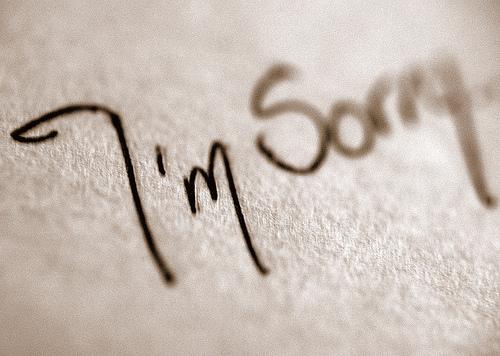
I’m completely in love with Grey’s Anatomy. I love it all, but I do have a favourite scene. It’s the very last scene in an episode called No good at saying sorry. But the thing that gets my attention is not whats happening in the scene, but whats been said in the voice over.
As Doctors we can’t undo our mistakes, and we rarely forgive ourselves for them. It’s a hazard of the trade. But as human beings, we can always try to do better, to be better, to right a wrong, even when it feels irreversible.
Of course, ‘I’m sorry’ doesn’t always cut it. Maybe because we use it in so many different ways. As a weapon, as an excuse.
But when we are really sorry, when we use it right, when we mean it, when our actions say what words never can, when we get it right I’m sorry is perfect.
When we get it right, I’m sorry is redemption.
I find these words compelling – especially that last line. When we get it right, I’m sorry is redemption. I’ve been pondering the different ways that this is true in the life of a Christian. First its true for our relationship with Jesus. When we get it right, I’m sorry is literally the redemption of our souls.
Now, I’m pondering the place of ‘I’m sorry’ in our relationships with one another. I’m hoping (probably because I know there’s an ‘I’m sorry’ I need to say) that its redemption for our friendships too. Of course, when we say it to Jesus we know its met with forgiveness. With each other, I guess we need to take a risk. And hopefully, when we get it right, I’m sorry is redemption.
Giving up chocolate for a year sounds pretty insane to me. But family friend, 16 year old chocoholic Caitlin, is doing just that. Crazy! But its all for a very worthy cause.
Caitlin is raising money for STOP THE TRAFFIK – an organisation whose aim is to PREVENT the sale of people, PROTECT the trafficked and PROSECUTE the traffickers.
She is also blogging about her year without chocolate here. Show her the love by visiting her blog and, even better, donate money to STOP THE TRAFFIK here.
Don’t worry, no-one died. Actually Andy Irons did but this is not about him. Well, its a little bit about him, because the phrase ‘rest in peace’ appeared on my Facebook homepage several times today. Not unexpected really – happens every time someone dies. Rest in peace. What I do find slightly unexpected is when my Christian friends use it. Maybe its a deficiency in my understanding but I’m not really sure what it means when Christians say it. That is, I don’t know what they are trying to express when they say it.
As Christians we know this
27 People are destined to die once, and after that to face judgment. Hebrews 9:27
We also know this
36 Whoever believes in the Son has eternal life, but whoever rejects the Son will not see life, for God’s wrath remains on them. John 3:36
Some will rest. They’ll rest in peace because they rest in Jesus. And for the others – this pithy expression of sympathy seems disingenuous at best.
Came across this quote in my exam prep. Food for thought –
“If, then, a man is not oppressed by his environment, if he has nothing serious to fear or to suffer at its hands, he has reason carefully to ask at least whether and how far he is genuinely a Christian at all and not fundamentally self-deceived in this respect.” – Karl Barth


 a girl who speaks