Mission in the nation’s capital

Once again the time has come for Moore College to send us out into the world (literally) to partner with churches for a week of mission. While many of our teams will be Sydney based, there are a few teams heading a little further.

This year my mission team is heading to Canberra to work with Crossroads Church for 8 days, starting Sunday. Much excitement!

But we’re not the team going the furthest. One team will be on planes this weekend, heading to Hong Kong for the week.

If you want to know a little about what we do on mission read about my last 2 years here.

It’s always a busy week and of course we’d love your prayerful support as we head out. If you’d like to pray for us, or if you would just like to know what’s happening, you can read updates from all the teams on the moore college mission blog. I’ll be over there, keeping you updated on behalf of the Canberra team.

You can also follow the #mooremissions tweets.

Identity & Sexuality: Part 1

Issues of human sexuality and how it relates to our identity are more and more becoming crucial and much talked about issues in our culture. It’s hard, if not impossible, for Christians to shy away from these discussions. And while they are complex issues, shying away from them is one of the worst things we can do. We need to be prepared to engage at some level.

It makes sense that if we what to start to answer the question of who we are we should look at where we started. The beginning of humanity – the 6th day of creation.

Then God said, “Let us make man in our image, in our likeness, and let them rule over the fish of the sea and the birds of the air, over the livestock, over all the earth, and over all the creatures that move along the ground.” [Genesis 1:26]

Humanity stands out here as the only thing to have been created in the image of its creator. We bear the image of a trinitarian God, who is eternally in relationship with himself. So to be human is to be relational.

It’s this that differentiates us from the animals that we are to rule over. But that’s not all that is different between Adam and Eve and the animals. Here’s what we’re told about the animals

And God said, “Let the land produce living creatures according to their kinds: livestock, creatures that move along the ground, and wild animals, each according to its kind.” And it was so.  God made the wild animals according to their kinds, the livestock according to their kinds, and all the creatures that move along the ground according to their kinds. And God saw that it was good. [Genesis 1:24-25]

The animals are produced and arranged according to kind. And there are many kinds. Humans are their own kind – there’s a reason we call it called humankind. But what we do see, which we don’t for the animals, is gender. Part of being made in God’s image is being made male and female. We are different, and yet of one kind and together image bearers of God.

In the last few weeks, as part of some sermon prep. I’ve been reading some writing of several Queer Theorists who would like to convince us that gender is fluid. It’s not set in stone and it can be changed easily because it’s not based on our physiology but on some transitory feeling within us. But Genesis shows us a very different picture than the one they are trying to sell us. Gender is there in the very first description of humanity. Before we’ve heard a word from either of them, we’re told they are created male and female. Their gender isn’t fluid because their male and femaleness isn’t based on how they feel. They are male and female simply because God made them that way.

You’ll also note that they are described as male and female rather than man and woman. This is because the Hebrew words for male and female are intended to express sexuality. To be human is to be a sexual person. So gender has played a role in the first introduction to both humanity and sexuality.  The sexual bond of the man and the woman are part of God’s good creation and integral in his purpose for them to fill and subdue the earth.

Genesis doesn’t leave room for the confusion of gender or sexuality. Being male and female is fundamental to both our identity and our sexuality. And it’s part of the creation that God declared was very good.

Death is not the worst thing

Today was kind of a strange day for me. Instead of spending it hanging out with my fellow MTC 4th year buddies I spent it with my sisters, trying to work out what contribution we wanted to make to our grandmother’s funeral on Tuesday. We were very close to my grandparents on mum’s side, and the 4 of us were their only grandchildren. When Grandad died I felt like I had tonnes of memories I wanted to share with people – so many good times to look back on. The memories were so fresh then. But not so with Grandma.

I feel like I’ve actually had two grandmothers in one. The first – the one I love so much, is the Grandma whose house we spent every school holidays at because mum & dad both worked. The Grandma whose house my older sister and I were quarantined to when we had the chicken pox. The Grandma who, along with my Grandad, turned up at our house 6 weeks into their 6 months camper van trip around the country, because they missed us too much. Instead they packed up me and my sisters (I was 10, my sisters 13, 7 & 5) and took us on a 4 week trip to Cairns. Probably the greatest holiday of my life and only 1 of many they took us on over the years.

The other Grandma only appeared 6 years ago. The Alzheimer’s started long before that, but 6 years ago Grandma became an old woman who didn’t know who I was anymore. By the time she died there wasn’t a single person in this world that she recognised.

I’ve heard it said that death is not the worst thing that can happen to a person. For Grandma this is certainly true. She was a woman who loved Jesus and served him with her whole life. Death was the best thing for her.

On Thursday she had surgery to pin a broken femur, and on Tuesday she died from post operative multi-system organ failure. Alzheimer’s may not have killed her, but it took her life from her years ago. It was back then I grieved the loss of my wonderful grandmother. For that reason I don’t feel sad that she died. We lost her 6 years ago and we have grieved for all those years. I do feel sad that the last 6 years are the freshest memories right now. I hope they fade and I start to remember the 24 amazing years before that. But I also don’t want to forget the last 6 years completely, because they remind me of this truth

Listen, I tell you a mystery: We will not all sleep, but we will all be changed – in a flash, in the twinkling of an eye, at the last trumpet. For the trumpet will sound, the dead will be raised imperishable, and we will be changed.  For the perishable must clothe itself with the imperishable, and the mortal with immortality. When the perishable has been clothed with the imperishable, and the mortal with immortality, then the saying that is written will come true: “Death has been swallowed up in victory.” [1 Corinthians 15:51-54]

When I think about that I feel indescribable joy – because God is good and faithful to his promise. Death is defeated and my Grandma lives! She is raised imperishable with a body and mind that work. Praise Jesus that she is home with him. I look forward to joining them one day.

Are Christians our own worst enemy??

Today I had the privilege of being a part of a Q & A session at a high school Christian lunch time group. On any given week the group is usually about 30 kids. Today it was 45. It’s an unusual group because about half of the 30 regulars are not Christians. Obviously the Christian were out numbered today.

A few months ago the group set up a board in the school asking students to complete the following – “My biggest problem with Christianity is…”

Over the last few months the leader of the lunch time group has set out to address the issues people have. Today’s challenge was to answer the question of what Christianity has to say about homosexuality. It was a tough gig but very worth while I think.

Something that really hit me as I was listening to their objections, was the way they were very quick to attack what the Bible says, without actually knowing what the Bible says. Of course Leviticus was mentioned more times than I could count, but there was a complete ignorance to anything else the Bible has to say about homosexuality, or in fact, any kind of sexuality. There were some genuinely shocked faces when I said the Bible has lots to say about sex.

But I don’t really blame them. I suspect they are repeating the only info they’ve ever heard about the Bible and homosexuality. A week ago I meet with a teenaged Christian girl to think about these same issues. When I asked her “why does the Bible say homosexuality is wrong” she had a hard time answering. Eventually she said “I don’t know, all I know is that the Bible says its wrong”.

I’ll admit I’m kinda thinking out loud, but I feel like this is our fault, for having the wrong conversation for so many years. We need to not talk about the fact that the Bible says its wrong (cause everyone knows that anyway) and instead talk about the presuppositions that sit behind the conversation. For example, some things I noticed that all the students today assumed are – all desire is good, sex is a right for every person, and sexuality is integral to identity. The Bible has a lot to say about these 3 assumptions and without addressing them, anything the Bible says about homosexuality makes no sense.

I think unless we start moving the conversation we are our own worst enemy. What do you think?

“tomorrow will worry about itself”

Therefore I tell you, do not worry about your life, what you will eat or drink; or about your body, what you will wear. Is not life more than food, and the body more than clothes? Look at the birds of the air; they do not sow or reap or store away in barns, and yet your heavenly Father feeds them. Are you not much more valuable than they? Can any one of you by worrying add a single hour to your life?

And why do you worry about clothes? See how the flowers of the field grow. They do not labor or spin. Yet I tell you that not even Solomon in all his splendor was dressed like one of these. If that is how God clothes the grass of the field, which is here today and tomorrow is thrown into the fire, will he not much more clothe you—you of little faith? So do not worry, saying, ‘What shall we eat?’ or ‘What shall we drink?’ or ‘What shall we wear?’ For the pagans run after all these things, and your heavenly Father knows that you need them. But seek first his kingdom and his righteousness, and all these things will be given to you as well. Therefore do not worry about tomorrow, for tomorrow will worry about itself. Each day has enough trouble of its own. [Matthew 6:25-34]


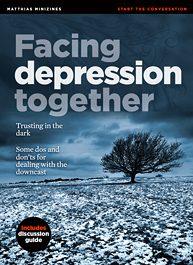
Facing depression together

A few weeks ago I bought this MiniZine from Matthias Media and I finally made time to read it over the weekend.

It has 2 excellent articles on depression, one from a sufferer describing his experience and the difference the gospel makes to those who struggle with Depression & Anxiety.

The other (by Mark Baddeley) is titled ‘Dos and don’ts when dealing with the downcast’ and is an excellent starting point for those who haven’t suffered from depression and find themselves not knowing how to best help those who do. There were 2 things that struck me particularly – probably because I’ve done such a bad job in past.

So if you’re strong and you’re faced with someone weak, your job is to bend down, get down where they are, and lift some of the burden and carry it for a bit. It isn’t to say, “Cheer up mate! Things aren’t as bad as you think. Be strong and trust God.” That is the perennially instinctive thing to say, and it is so because it is cheap.

It is the same kind of love that says “Be warm and well fed, and, by the way, God loves you” when faced with a homeless person. It costs nothing, but just tries to fix the problem quickly in order to remove its challenge to love that person in their concrete situation. It is like the person who intervenes in a supermarket to give the upset child that lolly they’ve just been denied. That person doesn’t care about the child’s welfare; they just want to stop feeling bad because the kid’s upset. The person who really loves the child did something costly and told them ‘no’ when an easier path was clearly open. In biblical terms, such cheap ‘love’ is ‘hate’ that has simply learned to ape its betters. It is faith that is dead, but dead before rigor mortis sets in.

Carrying the burden will look different for different people, but usually it means letting the weak person talk frankly about their life at the moment—listening rather than offering solutions, allowing them to suck some of your emotional energy away, and giving them some of your excess, even if it puts you in the red for a bit.

And

The priesthood of all believers means that I am your priest and that you are mine at the same time. I can be an instrument of the grace of God to you, and you can be one for me. I can pray for you and you can pray for me.

There are times when I can stand before God on your behalf when your faith fails you and you need someone to do for you what you cannot do for yourself, but what you so desperately need to have done. Like the four friends of the paralytic, we can carry the crippled, rip open the roof and present our friend right in the presence of the throne of grace (Mark 2:1-12). And like in that account, it might not always be entirely clear whose faith was the instrument for the grace of God to operate.

What does such faith operating on behalf of someone else look like? It is faith that is active, doing what that person would do if they could do it, and doing it in such a way that it overflows and feeds them.

So rather than encouraging them to pray, you pray for them, and as best as possible, try and express their feelings and perspective to God, and hand the problem to God. Do that with them present. Acknowledge and give dignity to their downcast experience by articulating it in prayer. By doing that, you implicitly show that it is not the final word.

So rather than calling on them to trust God, give them a reason to trust God. Just talk about how great and good God is; how his mercies are ever renewed; how we don’t have to muster up faith to get access to his grace; how he holds us up even as we trip and fall; how the Father who gave up his eternally loved Son for us when he and us were at each other’s throats is a Father who is really there for us now that we are his children. Just talk about God to them—as though that is life itself. And don’t finish by saying, “So buck up and trust him, okay?”; finish by saying, “He’s on your side; he’s going to carry you through this, however bad it gets”. Sometimes it’s okay to just declare the promises of God and not ask for any response in the short-term.

According to a 2007 national survey, there are around 1 million adults and 160,000 young people in Australia living with depression. This is roughly 1 in 5 women, and 1 in 8 men (info from beyondblue.org.au).

Depression is an issue that is going to effect each of us in some way so I highly recommend these articles as a great place to start understanding it better and learning how to care for those around us. You can buy a paper copy here or PDF here. Mark Baddeley’s article can also be read online here.

Confessions of a new believer

Great little series from Hayley.

The quotes have been taken directly from my journal and emails during the early days of becoming a Christian. I’ve tried to keep them as true as possible to the stream of conscience that wrote it – so sorry in advance for the grammar! Some things are just funny and some are insightful.

My hope is that this series of posts “18 Confessions” would deepen the believers empathy for those seeking out the faith and bring insight into the internal wrestles of a new Christian or perhaps if you relate to the thoughts or struggles in these posts that you would consider the lasting satisfaction and joy that is found only in Jesus.

Read them here.

While your there, check out Hayley’s story.

Think like Jesus

Each of you should look not only to your own interests, but also to the interests of others.
Your attitude should be the same as that of Christ Jesus:
Who, being in very nature God,
did not consider equality with God something to be grasped,
but made himself nothing,
taking the very nature of a servant,
being made in human likeness.
And being found in appearance as a man,
he humbled himself
and became obedient to death—
even death on a cross!
Therefore God exalted him to the highest place
and gave him the name that is above every name,
that at the name of Jesus every knee should bow,
in heaven and on earth and under the earth,
and every tongue confess that Jesus Christ is Lord,
to the glory of God the Father. [Philippians 2:4-11]

God, depression and hope?

Resurgence is doing a series on God & Depression based on Psalms 42 & 43.

I was very excited when I saw the first post – I love the Psalms and I think they tap into human emotions so well. I think the Psalms are a great example of how to express emotions in prayer to God. I particularly think they are helpful for people with depression.

Psalms 42 & 43 are great examples of this so I love that Resurgence are doing this series. However this comment in the latest post concerns me

We cannot live without hope, but there are countless things to hope in. Much of our depression may come from misplacing our hopes as we place too much hope in things which are not God. The Psalmist takes a look at what he has been hoping in — a revealing and convicting thing to do. We will find we need to repent for having our hearts set on things other than God, and in this way, bringing depression on ourselves. [emphasis mine]

This statement might be true for some people but not for everyone. And it seems like terrible advice to give to someone who is dealing with depression – surely telling them they need to repent of their depression (which is what they will hear you saying) is only going to make things harder for them. As for ‘bringing depression on ourselves’ – this is not the case for everyone. Depression is a medical illness for some and needs to be seen and treated as such.

I have read Psalms 42 & 43 over and over. I see no repentance expressed here. But what is beautiful is that 3 times across these Psalms the psalmist express his distress and immediate follows with the statement that his hope is indeed in God, his saviour. That is exactly the turmoil of depression – knowing that we have hope is God but feeling nothing but turmoil and an utter lack of hope. This problem needs grace, love and patience but not repentance.

Why am I so depressed?
Why is this turmoil within me?
Put your hop in God, for I will still praise him,
My saviour and my God.          (Psalm 42:5,11 & 43:5)