The problem with forgiveness

I’ve been pondering this for the last few weeks. The problem with forgiveness is it’s hard. When we’re hurt, the precious and sought after ‘I’m sorry’ rarely satisfies. It never changes what happened. It certainly is no magic fix to relationships. So even when we’ve heard the words, we must choose to put aside our hurt if we are to forgive. As much as we’d like them to, no-one can take the hurt away. We absorb it ourselves. True forgiveness means giving up the desire for vindication (or revenge).

But what about when forgiveness seem impossible? Like when a man walks into a school and shoots 26 people. How does anyone forgive him? Even if an apology helped, it’s not possible. Not even the strictest of guns laws will restore the life that was lost. No mental health care improvements will ease the pain for those who grieve. How do we begin to even contemplate forgiveness in this situation?

As Christians we remember that we have been shown overwhelming forgiveness. That our own sin, which is just as evil as this man’s, has been dealt with on the cross. We remember that true justice is not ours to enact, but God’s. A day will come when he will judge in perfect righteousness. And we cling to the promise that Jesus will return and the world will be as it should.

Then I saw a new heaven and a new earth, for the first heaven and the first earth had passed away, and there was no longer any sea. I saw the Holy City, the new Jerusalem, coming down out of heaven from God, prepared as a bride beautifully dressed for her husband. And I heard a loud voice from the throne saying, “Now the dwelling of God is with men, and he will live with them. They will be his people, and God himself will be with them and be their God. He will wipe away every tear from their eyes. There will be no more death or mourning or crying or pain, for the old order of things has passed away. Revelation 21:1-4

And we pray come, Lord Jesus!

Holiness, not marriage

Image

I just pulled an old bible off my bookshelf and came across a post-it note I’d stuck in the back with this sentence on it

the goal is holiness not marriage

Honestly, I can’t remember when I wrote it. I assume it’s something I heard someone else say and wanted to remember. I have no idea who said it. 

I like it. Not because I’m against marriage (I’m not!) but because as Christians we should all be for holiness. Even, or perhaps especially, as a Christian it’s easy to feel like the goal of life is to be married, to buy into the idea that I’ll somehow be more complete if I get married. It’s also easy for other to perpetuate that belief (though probably unintentionally). But marriage is not the goal. Holiness is. 

But just as he who called you is holy, so be holy in all do, for it written: ‘Be holy, because I am holy’. 1 Peter 1:15-16

‘It’s a girl’. Why are these words so deadly for so many?

Last night I saw a documentary called ‘It’s a girl’.

In India, China and many other parts of the world today, girls are killed, aborted and abandoned simply because they are girls. The United Nations estimates as many as 200 million girls are missing in the world today because of this so-called “gendercide”.

Girls who survive infancy are often subject to neglect, and many grow up to face extreme violence and even death at the hands of their own husbands or other family members.

The war against girls is rooted in centuries-old tradition and sustained by deeply ingrained cultural dynamics which, in combination with government policies, accelerate the elimination of girls.

Shot on location in India and China, It’s a Girl reveals the issue. It asks why this is happening, and why so little is being done to save girls and women.

The film tells the stories of abandoned and trafficked girls, of women who suffer extreme dowry-related violence, of brave mothers fighting to save their daughters’ lives, and of other mothers who would kill for a son. Global experts and grassroots activists put the stories in context and advocate different paths towards change, while collectively lamenting the lack of any truly effective action against this injustice.

Here are some truly frightening stats from the documentary –

  • each year China & India ‘eliminate’ more girls than the number of girls born in the USA
  • each year in India 100,000 women are killed because they haven’t produced sons, or their husband and in-laws are unhappy with the dowry paid by her parents
  • dowries have been outlawed in India, however ‘dowry deaths’ still occur and are rarely investigated by authorities
  • female feticide (abortion due to discovering the baby is a girl) is socially acceptable in India
  • techniques used to enforce China’s ‘one child policy’ include forced abortion & forced sterilisation
  •  the ‘one child policy’ means that there are many more men than women in China. This leads to increased child trafficking from nearby countries and kidnapping of child brides

Horrifying.

The film shared stories of women who have killed baby after baby waiting to give birth to a son. But it also shared stories of brave women fighting to save their daughters lives.

One such women was Dr Mitu Khurana. Her husband and mother-in-law starved her for days, then feed her food they knew she was allergic to in order to get her to a hospital so they could bride a doctor to secretly find out the sex of her unborn twins (in violation of the PCPNDT Act). When it was discovered they were girls she was pressured to have an abortion. Instead she fled, gave birth to her daughters and now, years later, she continues to try to have her husband & doctors held accountable for what they did. In return she has been threatened with rape and the death of herself & her daughters if she doesn’t drop her complaint against the doctor.

Read more about her story here.

And visit itsagirlmovie.com to find out what we can do to speak for the voiceless girls around the world.

Collective Shout: crossed off list

Every year Collective Shout publishes a list of companies NOT to buy from this Christmas

You’re about to be bombarded. Bombarded with junk mail, TV, radio and outdoor advertising all competing for your Christmas dollar. Before you purchase gifts for your friends and loved ones, lets remember those brands that have excelled in sexploitation this year, the brands and companies that do not deserve your hard earned money. Cross ’em off your Xmas list! For our third year running (see lists from 2010 and 2011) we are making it easier for you to make ethical decisions rejecting of companies which have not demonstrated corporate social responsibility.

As a first this year, we’ve added a positive alternative: Toward the Stars, an inspiring on-line global marketplace for products for girls. And we’re hoping to be able to add our first major corporate to sign on to our Corporate Social Responsibility Pledge. (Watch this space!)

See the list here. Happy responsible shopping!

God redeems the despised things

At church we’re coming to the end of a 14 week sermon series in Levitcus and Numbers. I’ll admit that I was not particularly looking forward to 3 months in these Old Testament books but I’ve loved the way we have been constantly pointed to Jesus. I have been (once again) amazed at what Jesus achieved for us on the cross.

Today’s sermon was from Numbers 21

They traveled from Mount Hor along the route to the Red Sea, to go around Edom. But the people grew impatient on the way; they spoke against God and against Moses, and said, “Why have you brought us up out of Egypt to die in the desert? There is no bread! There is no water! And we detest this miserable food!”

Then the Lord sent venomous snakes among them; they bit the people and many Israelites died. The people came to Moses and said, “We sinned when we spoke against the Lord and against you. Pray that the Lord will take the snakes away from us.” So Moses prayed for the people.

The Lord said to Moses, “Make a snake and put it up on a pole; anyone who is bitten can look at it and live.” So Moses made a bronze snake and put it up on a pole. Then when anyone was bitten by a snake and looked at the bronze snake, he lived.

I was especially struck by this thought from the sermon:

A few chapters earlier (Num 11:6) the people had complained about the manna God gave them to eat. They took what should have been hope of life (food in the middle of the desert) and made it detestable. In chapter 21 God takes what is detestable (a snake) and turns it into hope of life.

Then this from John 3:

14 Just as Moses lifted up the snake in the desert, so the Son of Man must be lifted up, 15 that everyone who believes in him may have eternal life.

Once again, God takes what looks detestable and turns it into the ultimate hope for life everlasting.

Teen Sex by the book

A few months ago Dr Patricia Weerakoon visited our church to talk to parents about talking to their kids about sex and sexuality. Patricia has teamed up with Fervr and launched a new book – Teen Sex By The Book. In keeping with her style this book is an honest (ans at times explicit!) discussion about sex, culture and the countercultural way the Bible calls us to live. It’s written for teens but is also a must read for parents, youth workers and anyone who works with teens.

Here is Patricia talking about one of the many issues addressed in the book – is sexting really sex?

Get the book & see more videos here.

Urbandictionary.com says rape is for laughs

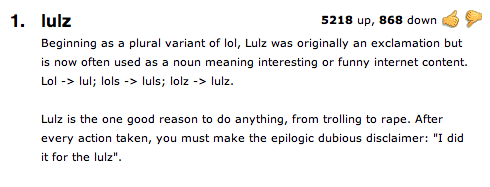
I happened to stumble upon this entry on urbandictionary.com today

Just in case you’ve somehow missed this, ‘lol’ is the internet/sms abbreviation of ‘laugh out loud’. So apparently getting laughs is the one good reason to rape.

Where to start with this?? I looked up urban dictionary’s terms of service. The ‘user conduct’ section includes the following

User Conduct

  1. Users may not post Content (as defined below) that:
    1. is unlawful, threatening, libelous or defamatory;
    2. violates any party’s intellectual property; or
    3. is detrimental to the quality or intended spirit of the Website.
  2. Examples of unacceptable Content or behavior on the Website include:
    1. abuse, harassment, threats of violence, flaming, intimidation of any person or organization, or any other threatening behavior;
    2. engaging in or contributing to any illegal activity or activity that violates others’ rights;
(emphasis mine)
Of course the terms of service also include this –
3. The Company has the right, but not the obligation, to limit or revoke the use privileges or editor account of anyone who posts unacceptable Content.
4. At any time, the Company can refuse to allow a posting or remove a posting at its sole discretion. However, Urban Dictionary is not obligated to restrict or monitor submissions in any way, or to block users who submit inappropriate content.

This leaves me wondering what exactly is the point of stipulating user conduct if you then free yourself from any obligation to hold people to that conduct?

Yet, I have given urbandictionary the benefit of the doubt, and emailed them about this entry. I am desperately hoping that they will recognise the extremely serious, destructive and illegal nature of this statement and remove it from their website. Hoping for a positive response from them.

emails can be sent to legal@urbandictionary.com

the problem with music …

… it’s so distracting!

So, right now I should be studying. And I was just a few minutes ago. As I study I like some music in the playing in the background so I love the shuffle button on itunes. It makes me happy. But sometimes a particular song will come on that completely distracts me from what I’m trying to learn (currently a history of Catholicism in Australia). Monday it was Adele. Her voice is just so incredible that as soon as she started playing I couldn’t concentrate on study. Today it’s this song.

The thing about ‘The Rose’ is that we have history. When I was 14 I started singing lessons and this was one of the first songs I was taught. Around the same time my uncle was in hospital dying. One day we went to visit him and he asked my mum if she could go to his house and find his copy of The Rose. It was his favourite song and he wanted to listen to it. Obviously we found him a tape to listen to, but that day I sat next to him and sang it for him. No music. Just a girl singing to her uncle. With every other patient in the room (and their visitors) listening. Simultaneously one of the most embarrassing and amazing moments in my life.

But now I just can’t stop loving the song.

Surprised by grief

It crept silently upon me from behind, disarming me in an instant, sweeping and swamping my emotional world. A sudden, perplexing grief I’d neither courted nor coaxed with negative thoughts, disaffected grumbling, hidden resentments nor murmuring discontent.

I’d not invited it, encouraged it, nurtured it, nor desired it. But, there it was…

This overwhelming sense of loss at never having, knowing, nurturing, or tenderly loving in the Lord, my own children…
Inexplicably and without warning, there it was.
It wasn’t that at that moment, or in the days and weeks that followed I didn’t ‘know with absolute certainty God’s love for me, or have an unswerving confidence in his sovereignty, or a trusting belief he’d not withheld anything good from me. I did.
Likewise, it wasn’t that I didn’t ‘feel’ with a heartfelt assurance my heavenly Father’s love for me, compassion for me, that he wanted only the best for me. Not once did I ‘emotionally doubt’ that he was intimately engaged and tenderly attuned to me, to all I was thinking, feeling & experiencing. All this I knew. All this I was confident of. All this I was comforted by – deeply so. And yet, there it was…
But, I also knew that for a single person to acknowledge such a grief, or express such a grief was not without its complications. Complications of perception, validation and acceptability…what do I mean?
Read Sarie’s beautifully honest post here.